· By Angela Seto
Heading into the honey flow
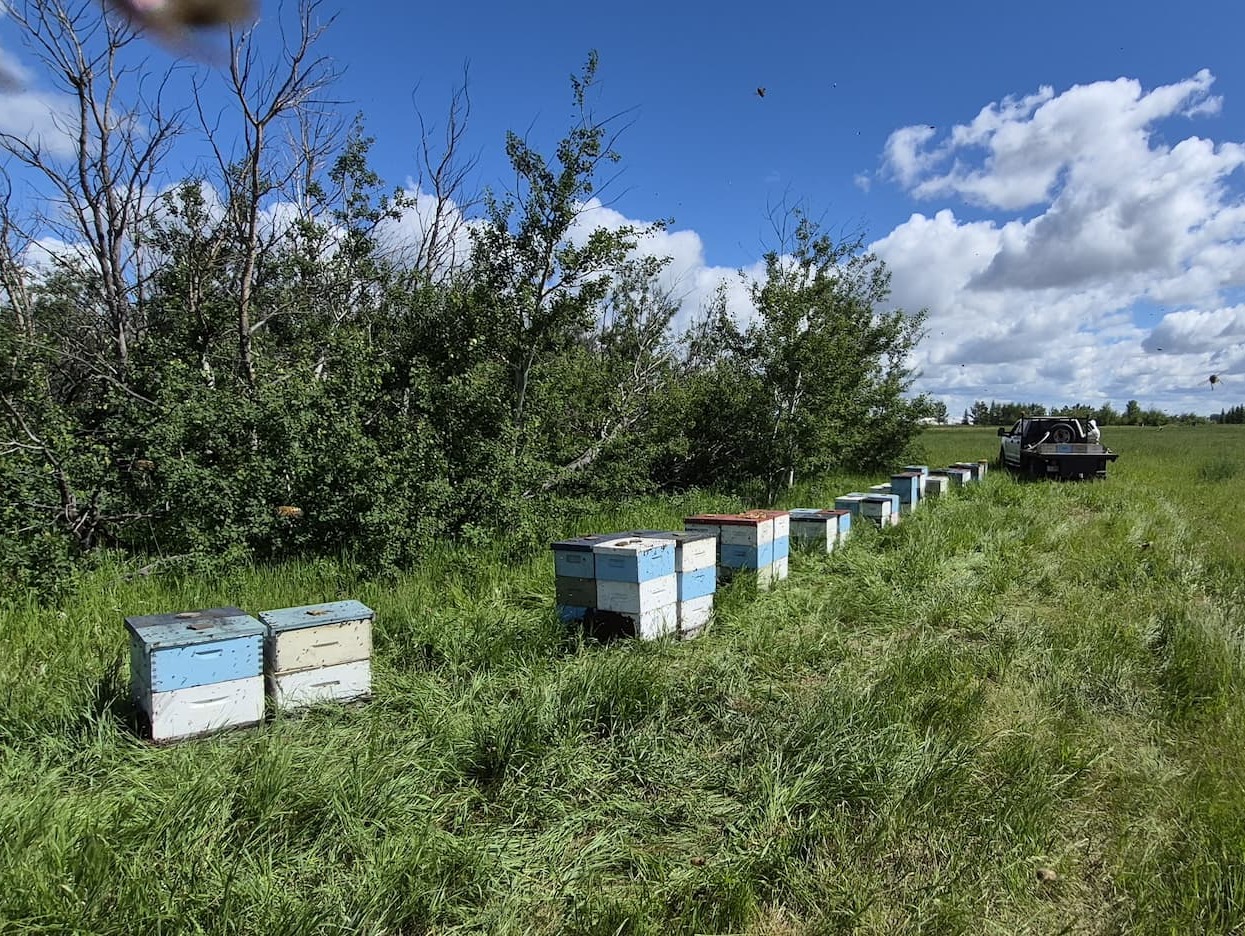
The first honey boxes going out on the yard. Each vertical stack is one colony. The bottom boxes are for brood, and the third box is for honey.
What's new on the farm:
With the official start of summer, the pace is picking up here in Saskatoon.
The big news this past week is that we started putting honey boxes out on some of the outyards!
The hives are bursting full, and the bees need room to put the nectar that they are collecting.
Some of the hives are so full that we're actually taking out frames of bees and brood (baby bees) to make room.
It's a great problem to have because we can use those extra frames and put them into struggling hives to give them a boost.
Even though we are putting the honey boxes on now, it will be some time before we actually take them off to harvest.
Bees collect nectar and make honey from spring until early fall, but there is only one part of the year that we can harvest honey.
The timing depends on the quantity of flowers in bloom and the population of the hives.
In the early spring, the hives are small and focused on growing. The number of workers compared to the number of baby bees they are taking care of is low.
At the same time, there are the early spring flowers that are in bloom, but there isn't an overwhelming amount of nectar that is out there. The best we hope for is that there is enough to keep pace with the growing hives.
All the honey that the worker bees make goes straight into feeding each other and making the baby bees strong and healthy. We don't touch it.
As spring turns to summer, the number of workers in the hive is much greater. There are also many more flowers in bloom with delicious nectar. The volume of nectar coming in starts to exceed the amount of food that the hive needs to grow.
When this starts, that's when beekeepers can put on honey boxes (also called "supers"). These boxes are separate from the brood boxes. The brood boxes are where the queen and baby bees live.
We put a screen called a queen excluder between the brood boxes, which are on the bottom, and the honey supers on top. This screen "excludes" the queen because it's narrow enough that the queen can't pass through, but the worker bees can. The queen stays in the brood box and can't lay eggs in the honey supers.
Once the brood boxes run out of room, the worker bees start moving up to the honey supers to fill them up with honey. When the supers are full, we remove them and take them to our extracting room to get the honey out of the frames.
Getting a good honey yield depends on many things. There has to be enough rain and moisture for the crops to produce an abundance of nectar, but not too much rain that it washes away the nectar when it arrives.
And you want to time the bees to be at their peak population at the same time that all the summer crops and wildflowers open up their blooms.
This is what we call the "honey flow".
So far, our hives are looking very strong and ready to go once the real honey flow begins. Keep your fingers crossed for us that we can keep this positive momentum going into the most important part of our season!
Our Creamed Honey wins Gold at 2026 Excellent Taste Awards

We submitted our pure Creamed Honey to the London Excellent Taste Awards this year and are excited to share that we were awarded Gold!
It's encouraging to get recognition at an international competition, and we are very proud of this result!
Recipe: Roasted Tomato Crostini with Hot Honey
When I found this recipe, I knew it was perfect for summer tomato season!
This is a very easy recipe that takes a bit of time commitment to roast the tomatoes in the oven, but otherwise is only 15 minutes of active prep time.
The tomatoes are caramelized in spicy honey, but you can absolutely swap that out for regular honey. They end up jammy, sweet, and rich with the natural umami flavor.
It's a great hosting appetizer and would be so easy to throw this together for a light meal with some crispy summer salad and a trout fillet thrown on the barbecue.
Check out the recipe from How Sweet Eats.