
· By Angela Seto
How nasty mites took over Australia's bees
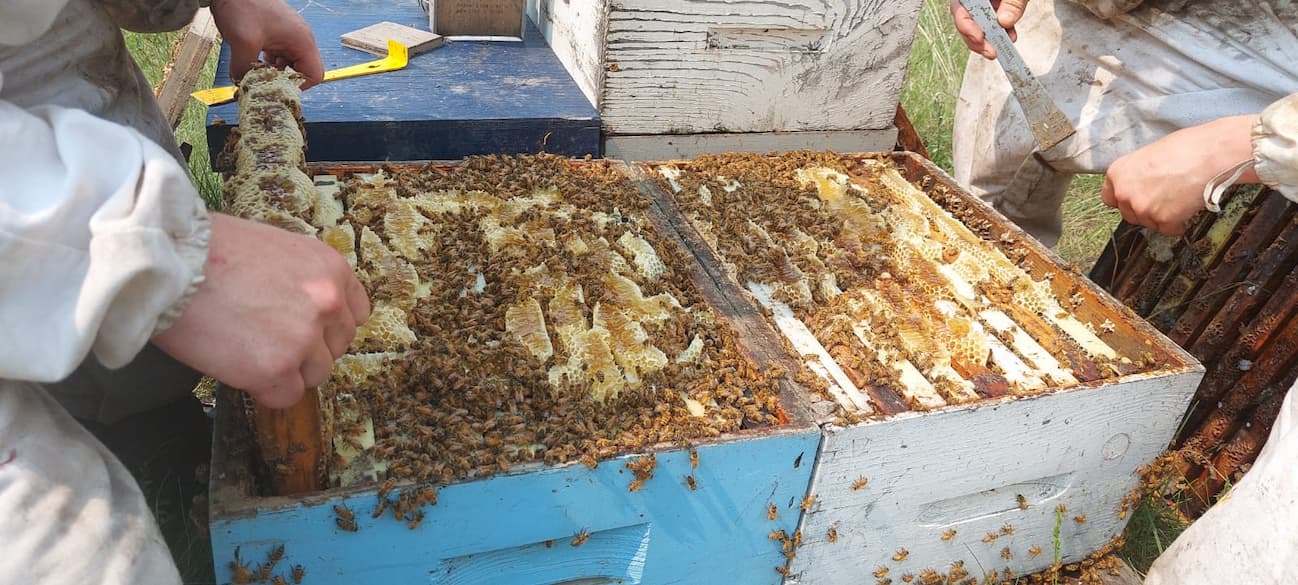
When it's wintertime, we like to look at summer photos of our beehives, especially strong ones like these!
What's new on the farm:
In mid-January, things are quiet on the bee farm.
There isn't a lot to do outside, so you spend the days preparing for the next season.
Andrew sets goals for what he wants to achieve.
How many producing hives (hives that we can harvest honey from) we will have. How much honey he wants to extract.
Then he works backwards from there to make sure he has enough equipment, labour, and inputs to get there.
Another big job is fixing up equipment and sourcing supplies.
He also does a lot of research into treatments for the bees.
While our goal is to have bees that are completely free of diseases and pests, you have to be proactive and have a plan ready.
I've written about the Varroa mite before, but for those who don't know, they are a nasty parasite that feeds on honeybees' blood and fat bodies.
They are currently one of the biggest problems in the beekeeping world.
They destroy hives by weakening the bees and spreading viruses.
The tricky thing about honeybees compared to other livestock farming, is that it is much easier to spread diseases if you're not careful.
Unlike cows or pigs, honeybees can travel far distances unsupervised.
That means they can also mingle with bees from other yards. And not only your yards, but other beekeepers' apiaries too.
Beekeepers are a bit territorial, and we all try to give each other space.
But sometimes you can have a yard on the edge of your territory that might be close enough to another beekeeper.
So you have to worry about not spreading mites throughout your hives, but also not getting it (or giving it) to a neighbor beekeeper!
Unfortunately, Varroa mites have spread across the world.
The last major region they reached is Australia, which has a significant beekeeping industry.
Before 2022, only a few cases had popped up in Australia and were quickly destroyed.
At this point, Australia was taking Varroa mites very seriously since they hadn't spread in the country yet.
At their major ports, Australia has a "Sentinel Hive Program."
These are groups of hives that are monitored at each port for new pests and Varroa mites.
They use them to detect problems early on before they spread to the rest of the country.
In 2022, they detected Varroa mites in the sentinel hives. Their guess is that the mites came on bees that hitchhiked on incoming cargo ships.
The government and industry immediately declared the Varroa mite as an emergency plant pest.
They set off to destroy the Varroa mite, but that meant the honeybees too.
Farms around the area were inspected. They traced the movement of bees and equipment to surrounding areas. Any farms that had Varroa were quarantined.
At the beginning, beekeepers were ordered to kill off hives that had major infections.
The hope was that they would sacrifice these hives to stop the spread to other hives.
Some beekeepers had to kill 1000s of hives at a time.
It was heartbreaking for the bees and the beekeepers.
I can't imagine the pain that everyone was going through to see all their bees and life's work destroyed.
In the end, about 30,000 hives were killed. Since the honeybees in Australia hadn't faced the Varroa mite before, the parasite easily took over.
After almost a year and a half, they realized that they were not going to be able to stop the spread by destroying infected hives.
The beekeepers would have to learn to manage the mites, like the rest of the world.
It's a sad story, but it shows how tricky pests can be and how fast everything can change.
It also shows how hard everyone works to protect bees, because bees help grow so much of our food!
Honey Roasted Sweet Potatoes
I love roasted sweet potatoes in the winter. They are so comforting and filling.
This recipe balances sweetness with acidity by combining a honey lemon butter that coats your sweet potatoes as they crisp up in the oven.
If you are a little more adventurous you can even try this with our Spicy Honey to add more depth!
Check out the recipe at Cheerful Cook.