
· By Angela Seto
I put a metal spoon in my honey...
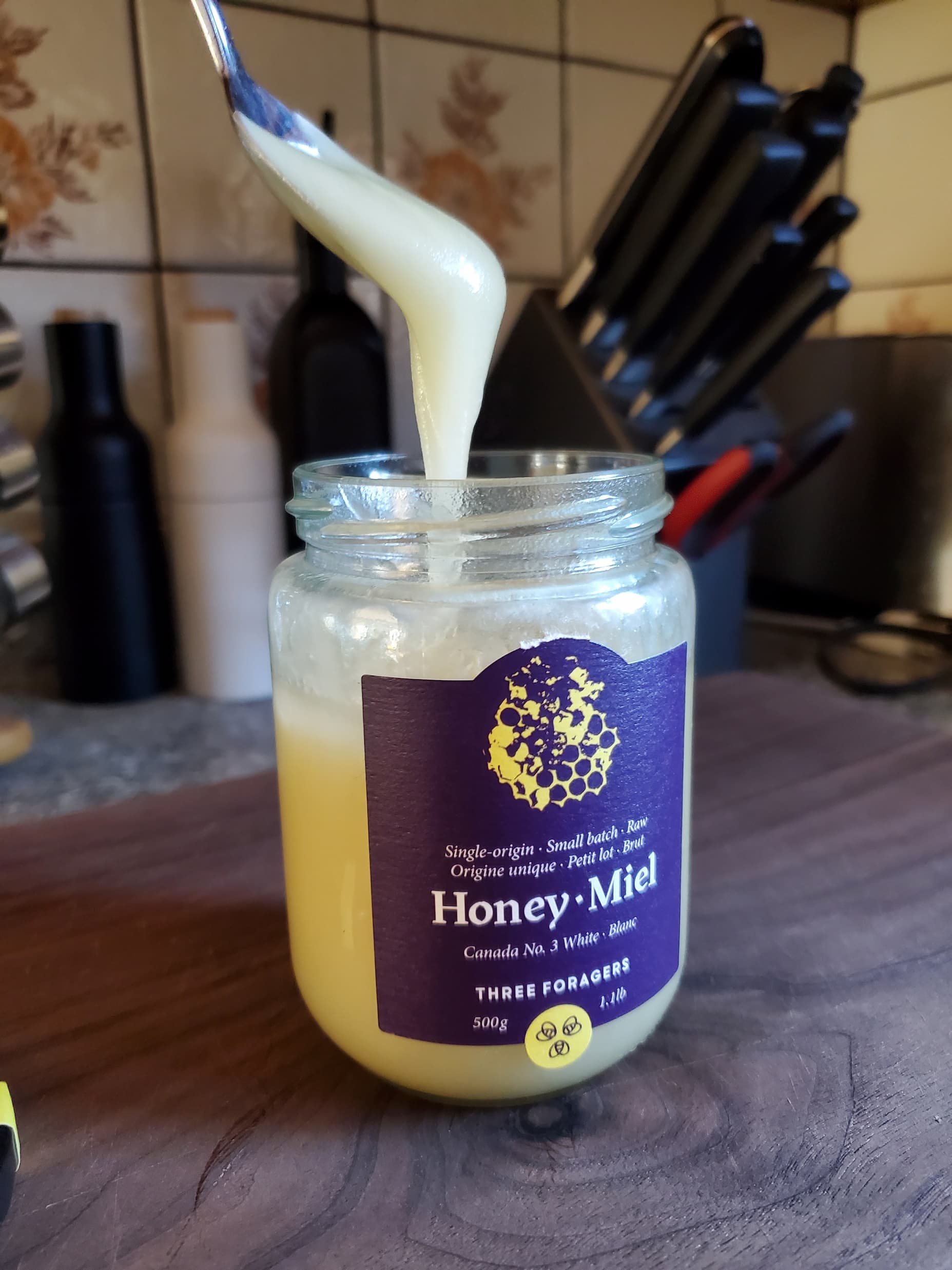
Can you put a metal spoon in your honey?
What's new on the farm:
Honey is an ancient food; everybody knows about it. That means there is a lot of information (and misinformation) about it.
Today I wanted to write about the most common honey myths that people still believe:
Myth #1: You can't use a metal spoon in your honey.
We get this one all the time. Especially since almost all our social media posts show us scooping our honey with a metal spoon.
The belief is that a metal spoon will kill the enzymes and ruin the honey.
Honey is an acidic food. The acidity naturally helps prevent bacteria from growing and is part of the reason why honey can last forever.
In the old days, metals like copper, tin, pewter, and aluminum were used to make utensils and storage containers. These metals are sensitive to acids. So when they are exposed to honey for long periods, the metals can corrode.
This results in potential contamination and can also leave a metallic taste in the honey. Again, however, this only happens when the metal and honey are in contact for long periods.
A brief swipe of honey with your spoon will have almost no effect, but if you stored your honey in an old metal tin for a while, it might.
This is likely how the myth originated.
However, these days, most storage containers are glass or plastic. And almost all modern utensils (since the 1950s) are made with stainless steel.
Stainless steel is non-reactive with honey. It has no impact on the quality or flavor of honey at all. It's also food-safe and easy to clean.
That's why all beekeeping extracting equipment and storage barrels are stainless steel.
And even considering all of this, the enzymes that are in your honey aren't even affected by these metals. They are, however, sensitive to heat.
It's when the honey is heated above certain temperatures that you see the enzymes degrade.
In the end, people should be more concerned about whether their honey has been heat-treated (also known as pasteurized) rather than the type of spoon they use to scoop it!
Myth #2: Local honey is the only honey that's good for you.
Buying local honey is wonderful. You support your local beekeepers directly, and you get to enjoy the flavors of the blooms from your region. This is a win-win.
However, we often receive comments that you should only buy local honey, and that all other honey is useless if it's not local.
The spirit of this comment is that local honey is supposed to help with your allergies. There may be some mild benefit to this, and people do report feeling relief from their seasonal allergies when they use local honey in their diet.
However, that doesn't mean that all other honey has no place in your kitchen!
All unpasteurized, unfiltered honey is effective at soothing coughs and sore throats, reducing inflammation, and can help improve cholesterol [1][2][3].
If you are a hot sauce fan, you probably have at least a couple of different kinds of hot sauces in your kitchen.
Even with sugar, you can have white sugar, brown sugar, cane sugar, for different uses.
I see honey the same way! There's no reason why you can't enjoy different varieties of honey from all over the world, because there are so many wonderful kinds out there.
Myth #3: All honey is the same.
I can see why people believe this one: if you only shopped for honey at a big-box grocery store, all honey would look the same!
That's because mass-produced honey is often processed to be uniform, golden, and liquid. That matches the stereotypical appearance of honey that people have in their minds.
And for large-scale producers (in every section of the grocery store, not just honey), the most important thing is consistency and shelf life.
There is a honey color grading scale for beekeepers to use when grading their honey. It ranges from "water white" to "amber".
The color of the honey depends on the botanical source of the honey. That means it's the different flowers that make honey taste and look unique.
For instance, Alfalfa honey from Saskatchewan like ours is white and thick. Manuka honey is dark and caramel. And Tupelo honey from Florida is golden-green and runny. Buckwheat honey from Manitoba is like molasses! And of course, many varieties of honey do look golden and runny.
But why is all the honey in the store the same golden color, right in the middle?
To get the same color every time, producers will buy light colored honey, and dark colored honey, and mix it.
Some different sources of honey will also crystallize faster than others (like ours!).
So these processors will pasteurize and ultrafilter the honey (I'll talk about those processes another time) to delay the crystallization process.
But honey wants to crystallize; it's just natural. And it always does in the end (except for Tupelo...), but when the natural process is disrupted, the crystals aren't very pleasant.
That's when you get those gritty, hard crystals. In comparison, unpasteurized honey often crystallizes into fine, uniform crystals.
Not to mention the pasteurization will degrade all those enzymes that we talked about in Myth #1!
So if you skipped the grocery store and you tasted honey right from the farm or from the beekeeper, you'd get to taste so many different flavors, and see so many different colors and textures of honey. And that's a good thing!
So there you have it for today. Three of the most common honey myths we hear.
If you've got a honey question or myth you've wondered about, hit reply and tell us. We love hearing from you.
References:
[1] https://pubmed.ncbi.nlm.nih.gov/32817011/
[2] https://pmc.ncbi.nlm.nih.gov/articles/PMC7807510/
[3] https://pmc.ncbi.nlm.nih.gov/articles/PMC9149702/