
· By Angela Seto
Living with 150 queen bees
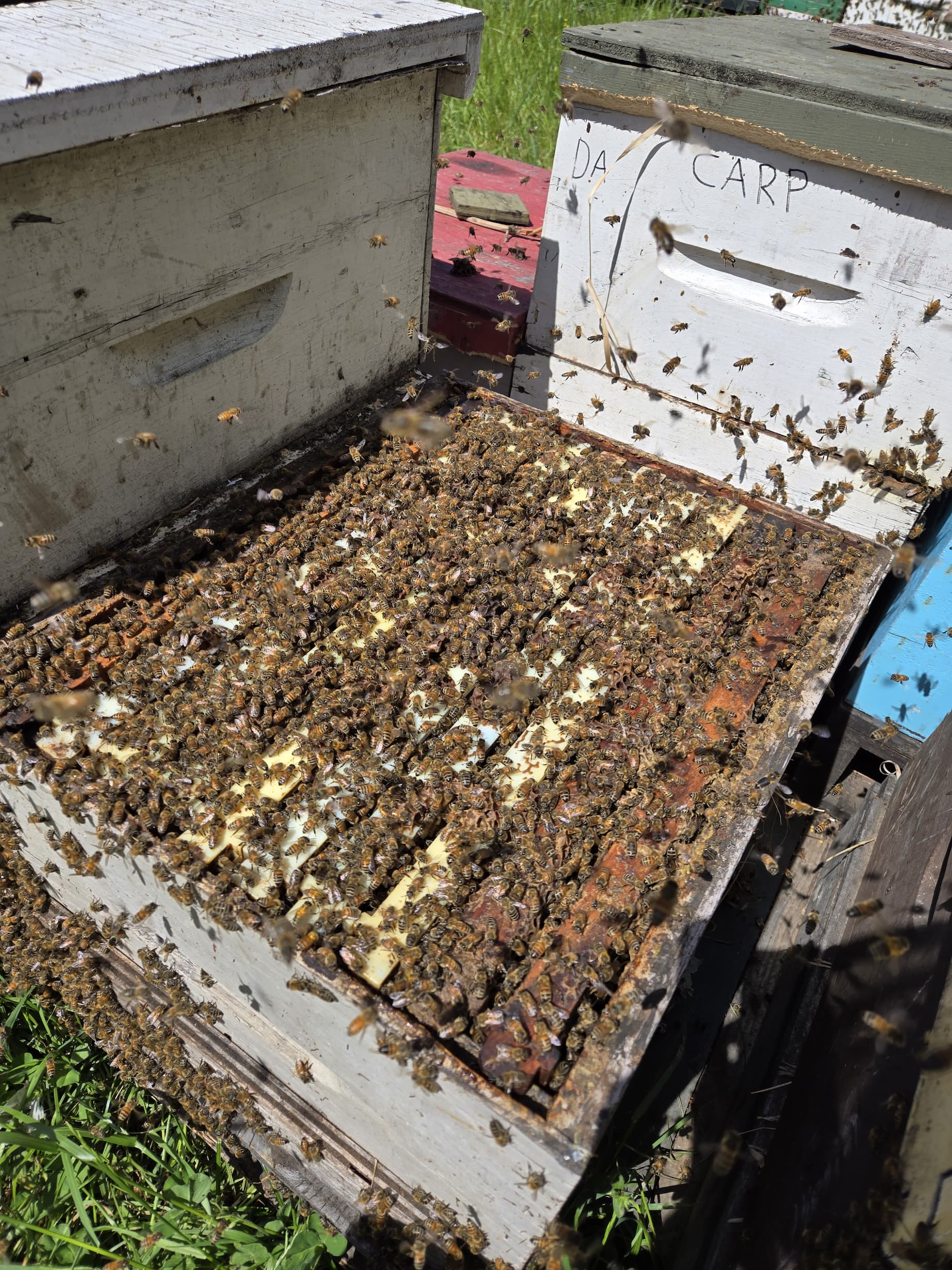
A big, strong hive ready to be split into two!
What's new on the farm:
I can hear the hum of 150 queen bees and their attendants sitting a few feet away from me in the living room.
That means the new queens that we ordered arrived on Vancouver Island!
They flew from California to Toronto. And then Toronto to Vancouver. Finally today they finished the journey from Vancouver to Nanaimo. Thousands of dollars worth of bugs, making their way back and forth across the continent.
Each queen is shipped inside a small cage with several worker bees that help take care of her. There is also some sugar candy in the cage, so they have something to eat.
The first thing we do is check each cage to make sure the queen is alive.
Then we give every cage a drop of water so the bees have something to drink. After a couple of days traveling in the belly of an airplane, they are pretty thirsty.
Since honeybees are sensitive to temperature, we keep them in our home so that we can keep an eye on them.
It's not unusual during the season to have a few hundred cages of bees buzzing next to us as we wind down in the evenings.
Andrew and the crew spent this past week making new hives (splits) that will be home to the new queens.
They took the strongest hives and divided up the developing baby bees (brood) into two boxes. One box kept the existing queen. The second box had no queen and was moved to a different bee yard.
This is so the worker bees inside wouldn't fly back to the first box with the queen, and would be accepting of a new queen.
This week, they'll take the queens sitting in the living room, and place one each into the splits that are waiting for a new queen to take over.
When a new queen goes into a hive, the worker bees see her as unfamiliar, and often may try to attack her. For that reason, we don't let the queen walk free in the hive right away.
Instead, we keep her in the cage for a few days and let the worker bees get used to her presence.
To help the bees accept the new queen, her special scent (called pheromones) needs to spread through the whole hive.
This smell spreads by touch. Worker bees touch the queen through the cage and pick up some of her pheromones on their bodies. As they move around the hive doing their normal work, they pass the queen's smell to the other bees.
After a few days, the entire hive is used to her smell and will see her as their own. Then we can release her from the cage.
Once we release her, we still watch how the worker bees around her react to make sure that they accept her. There have been times we have had to rescue a queen because they will start biting and attacking her!
Then, we leave the hive alone for around a week before we check in to see how things are going.
There's nothing quite like the feeling of checking a hive and seeing a beautiful new queen laying eggs like a busy little machine.
Proof that another strong colony is off to a great start!
Baked Feta with Honey
This is a great dish for hosting. Cheesy and gooey to dip some fancy crackers or your favorite pita chips.
I love sweet and savory flavors, and adding unpasteurized honey really adds a lot of flavor!
The best part is that this takes hardly any time to assemble. With the weather getting warmer, it would be great to enjoy on the patio with company!
Check out the recipe at The Greek Foodie.