
· By Angela Seto
60 pounds of honey in 3 days
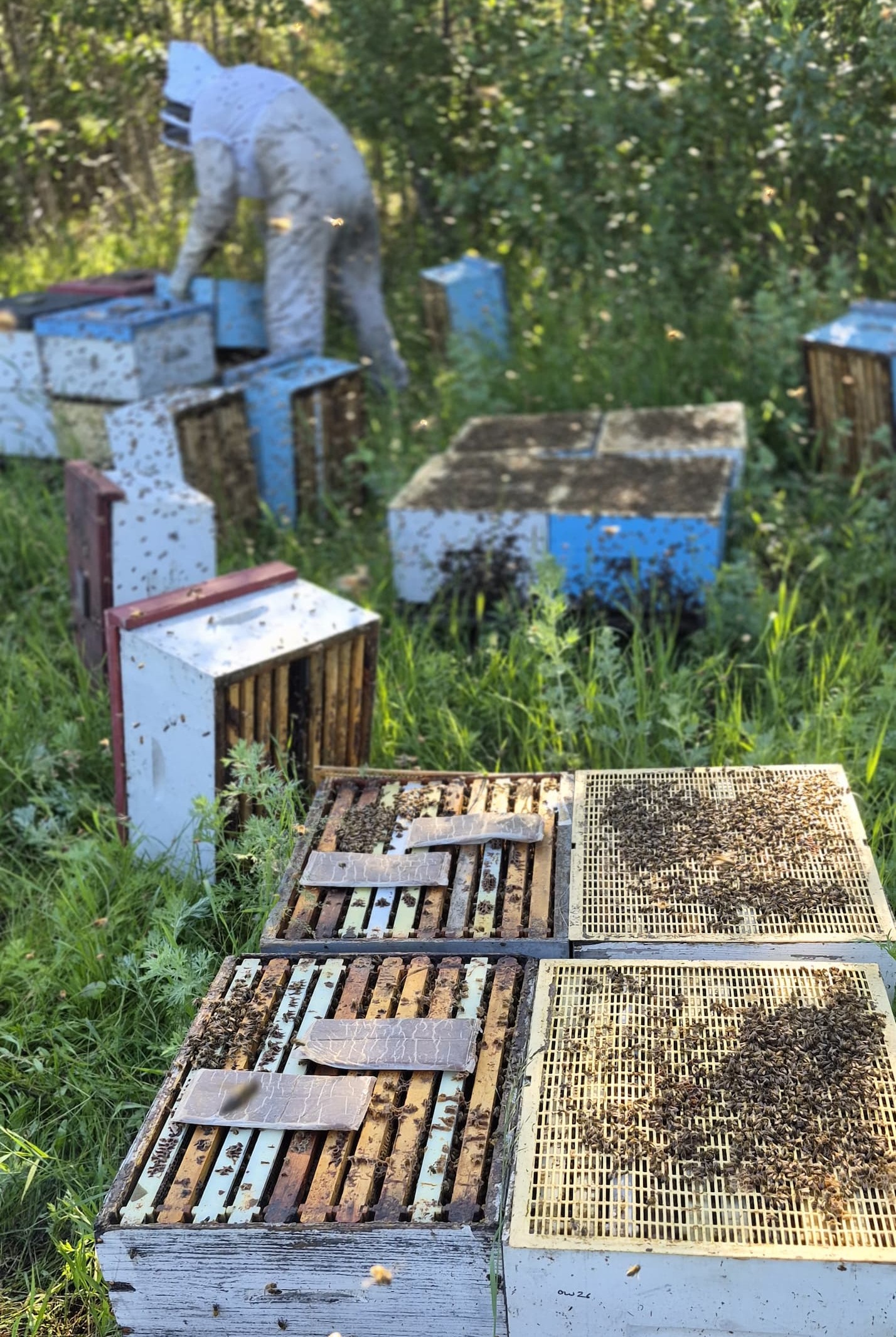
Our crew putting out formic acid pads on the brood boxes to help kill Varroa mites in the hives.
What's new on the farm:
Last week, I mentioned that we put some honey supers onto the hives, but it would be a while before they filled up.
This week, one of our yards proved me wrong!
On Tuesday, we visited one yard that was in a field of alfalfa flowers that had begun to bloom.
In preparation for honey harvest, we took the brood nest, which is spread out between two boxes, and consolidated it to one box.
Then we put two honey boxes (also called "supers") on top for the bees to store the incoming honey.
On Friday, we went back to the hives to apply a formic acid treatment to knock out Varroa mites. When we took off the honey supers, we discovered that over half of the hives had filled up the first honey super completely!
And better yet, half of those hives had actually filled up TWO supers.
That's around 60 pounds of honey per hive over two and a half days. The nectar was flowing in the fields, and those bees were busting their butts collecting it!
You can literally smell the nectar in the air. It's Andrew's favorite smell, and you can likely understand why that is!
As an aside, formic acid is the only treatment we choose to use during the honey flow, if we have to.
That's because formic acid is a unique organic acid that naturally occurs in honey. It cannot dissolve in beeswax, so it can't build up in the beeswax combs in the hive.
It also has high volatility and outgasses very fast, so it doesn't build up in the honey either. It's a powerful tool for us to control and kill the Varroa mite population without affecting the quality of the honey.
The next few weeks are going to be ramping up as more and more crops start blooming and the nectar flow gets heavier.
Fortunately, this year our hives are looking better than ever to capture that special nectar that will be transformed into delicious prairie honey!
Recipe: Grilled Hot Honey Chicken
Summer is barbecue season, even though we haven't had the warm weather to go with it here in Saskatoon.
I love the char on grilled chicken, and this recipe uses hot honey to add a big punch of flavor. You can make your own hot honey, or use ours to make it easy!
Prepping the chicken a day ahead takes only a few minutes and makes it super easy to come home, fire up the barbecue, and throw the chicken on for a quick weeknight dinner.
The recipe author even includes a fresh and delicious lime corn salad to pair with this dish!
Check out the recipe at How Sweet Eats.