
· By Angela Seto
The queen making has begun
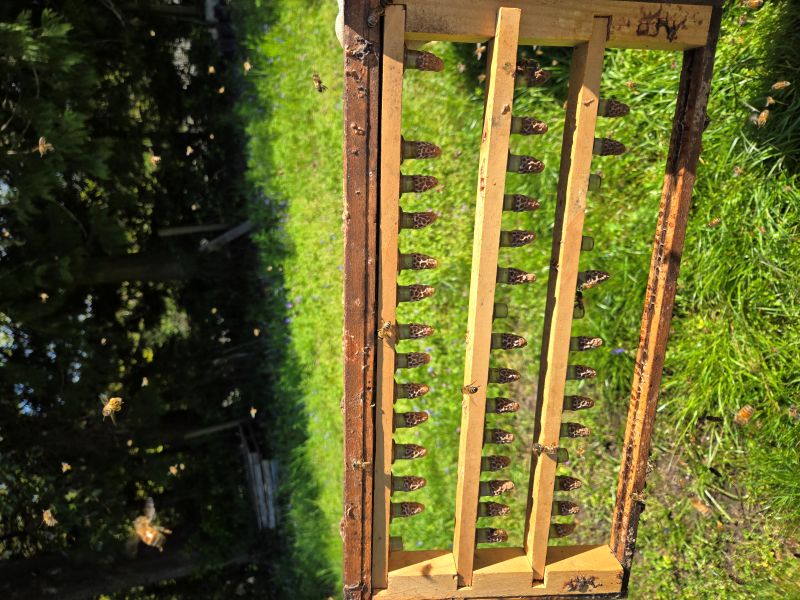
A frame of queen cells made from our own bees! Larvae are gently transferred into the grey cups, which are then placed with the open end upside-down in the hive. The bees feed the larvae with royal jelly for several days. Then they cover the cups by building out a beeswax "cell" (that looks like a peanut shell) so the larvae can turn into pupae. The pupae spin a cocoon inside the cell and stays inside until they emerge as a queen!
What's new on the farm:
This week, we put our first batch of queen cells into new, mini-hives.
In my last email, I wrote about buying queens from different parts of the world.
These queen cells came from our own bees.
It's great to introduce genetics from all over. It brings in different qualities that can help withstand different pressures.
But we also like to make queens from our hives that survived winter, because we know that they are hardy.
They are also conditioned exactly to our climates.
Early last week, I sat down to try my first "graft" of the season.
Usually, the first graft is a throwaway. The weather can be a bit too cool, or there isn't enough of a nectar flow to help the bees feel like there is abundance. Or the hives have no urgency to make new queens because their populations are too small.
But the first graft has to be done at some point. It's been many months since my last graft back in August. The first graft helps me warm up my technique to get back into it.
So what's a graft? Well, let's rewind a bit.
There is usually only one queen in a hive at a time. The queen is the only bee that can lay fertilized eggs and produce both worker bees (females) and drone bees (males).
She has fully developed ovaries and is sexually fertile.
Worker bees are infertile and do not have developed ovaries. In only extreme cases can they lay eggs, and when they do, the eggs are all unfertilized and produce drone bees.
A hive can't survive without a queen bee because it needs her to constantly produce more female worker bees. Worker bees do all the work in the hive. They feed, clean, gather food, build comb, and take care of all the bees. Drone bees only mate with a queen to provide sperm to fertilize her eggs, and that's it.
(Truly. Worker bees even feed adult drones. They don't have the right mouthparts to feed themselves. A drone dies immediately after mating, and not all drones get to mate with a queen).
So you can see, there are three types of bees in a honeybee colony. If you thought there was any genetic difference between a queen bee and a worker bee, you'd be wrong.
You see, what makes a queen, a queen, isn't anything special about her genetics.
It's the diet that the larva eats when it's developing into an adult bee.
Maybe you've heard of royal jelly. It's a highly nutritious product that's often used in supplements or skincare.
Royal jelly is a special food that's made by worker bees. Larvae that they have chosen to become queens are exclusively fed royal jelly during their development.
It contains a ton of special compounds, minerals, vitamins, and proteins that help the larva develop their ovaries, sexual organs, and body shape, which is larger than a worker bee.
Any female egg that a queen lays has the potential to become another queen if fed the right diet!
Now that you have that context, grafting is a very simple process.
Queen bees are larger than worker bees, so a developing larva that's going to turn into a queen won't fit into the same size cell that a worker bee grows inside.
To fit the queen, the worker bees fashion a special cup out of wax for the queen to lay an egg inside. It's larger in diameter and faces downwards to make the best use of space in the hive.
To mimic this, we have plastic cups with the same diameter that we can put inside a hive. We transfer larvae into these plastic cups so that the worker bees think these cells are supposed to become queen bees.
If everything looks good to them, they will start feeding those cells royal jelly.
But again, the conditions have to be just right, and you have to transfer the larvae very carefully without damaging them. Worker bees are very sensitive and will easily reject the transferred larvae if it's not perfect.
Typically, for me, the first graft of the season can be quite unsuccessful. I can get 0% take, or if I'm lucky, up to 50% take.
So my expectations were quite low. But I tried it anyway, and we ended up with an 82% take!
Five days after the graft, we take the cells out of the hive that we started them in, and we put them into a chicken egg incubator. This keeps the cells at the perfect temperature and humidity until they are ready to hatch.
Ten days after the graft, we have to put the queen cells into new hives that don't have a queen yet. Each queen needs to hatch into its own hive. If there are multiple queens in a hive, they will fight to the death so only one can lead the hive.
Before we bought an incubator, we used to leave all the cells in the hive for the full 10 days instead of moving them to the incubator, where they have their own compartments. There have been times when our timing was off, and a queen hatches early before we have separated them.
Then she will go kill the 30–40 other queens in the batch, while they are still helplessly growing in their cells!
Raising your own queens is a very particular process. Timing is critical, and you can't procrastinate or skip any steps.
I only described the first step in this email. As we go through the steps this season, I will share more.
Many things have to go right in a row to end up with a beautiful, healthy, laying queen on the other side.
Queen breeders will sell their queens for $35–50...some even $300. Can you imagine paying that much money for an insect?
In the beekeeping world, that's normal!
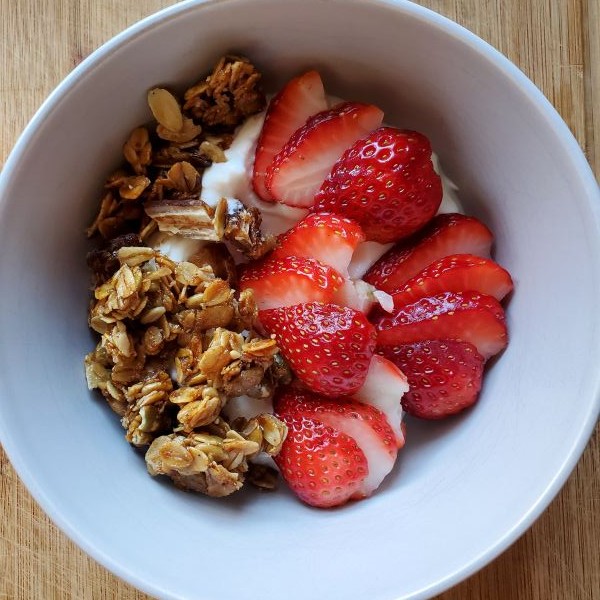
Homemade granola with strawberries on yogurt.
Healthy Honey Granola
I'm bringing back a favorite recipe from the archives...honey granola!
I love granola, but there is often too much sugar or corn syrup in the store-bought versions.
Making your own granola isn't cheaper, but you can control the quality of your ingredients, and the sweetness level too.
Plus, you can customize it to have your favorite seeds, nuts, and dried fruit.
Using honey adds another dimension to the sweetness since the recipe has so few ingredients! I like to use our Chai Honey since I love the taste of cardamom in my granola. Lemon Ginger would also be an amazing twist!
Check out the recipe from The Kitchn.
If you want to watch me make it, check out our Instagram reel!