
· By Angela Seto
Why we can't buy the best queens we've ever had
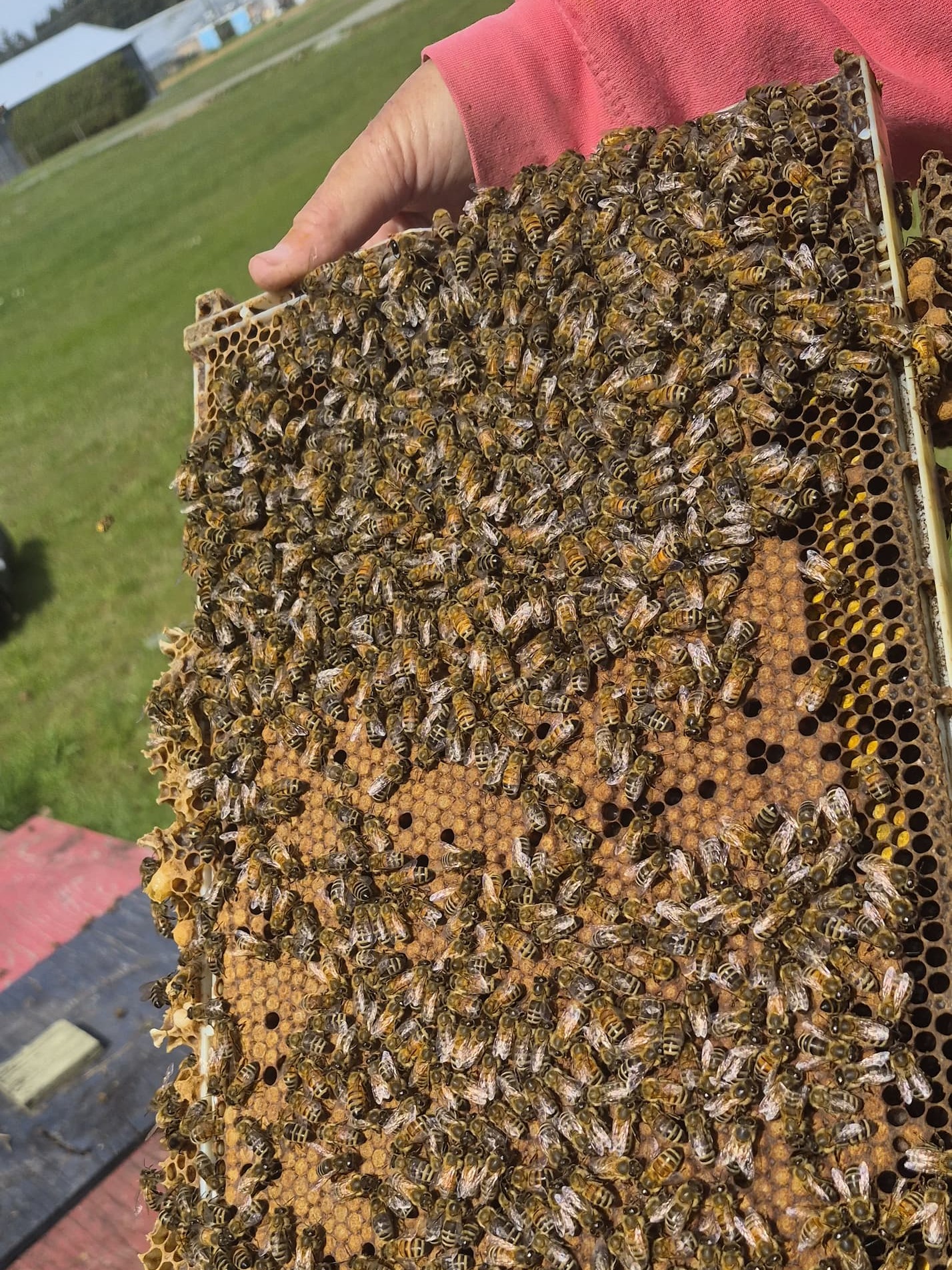
A very healthy frame of brood! The brown circles are baby bees (in the pupa stage) covered with wax cappings for protection until they hatch. A consistent and widespread pattern (without too many holes) means the queen is an organized and productive egg-layer.
What's new on the farm:
It was a bit of a chilly week with lows approaching freezing some nights and cool daytime temps as well.
That meant we couldn't work with the bees for a couple of days. Opening hives in chilly weather tends to do more harm than good.
On the days we did work, we were quite pleased to see how the hives were progressing.
The hives spend the winter in single boxes. We do this so there isn't any extra space that they have to warm up, which would be a waste of energy.
In the spring, as the populations grow larger, we add a second box to the bees. That way they have space to store the incoming nectar and pollen, and the queen has space to lay tons of eggs.
You can't just add a second box with no thought, however. Honeybees are very sensitive to their environment.
If you add a second box at the wrong time, it can change the growth rate of the hives. Too early, and the bees have too much space to keep warm and manage, which takes their focus away from taking care of the brood.
Too late, the bees start running out of space, and the queen has to slow down on laying eggs. The hive will also start preparing to swarm.
So you have to find the "Goldilocks" time to add that second box.
This week Andrew has been happily adding plenty of second boxes to the hives. They are healthy and growing at a good rate.
It helps that there are a lot of maple and cherry blossoms for the bees to feed on and power their growth.
With the hives growing, we also began to make plans for new hives (we call them "splits", since you split up the hive). We'll make these in a few weeks when the current hives grow large enough to split.
When you make a split, you can split up the bees, but you can't split the queen, since there is only one. So you can either put in another queen right away, or leave the hive to create their own queen.
It can take over 30 days before a new queen grows, hatches, mates, and is ready to lay eggs. During this process, there's a risk of the queen going on her mating flight and not making it back (from getting lost, or being eaten by a bird). So waiting for a split to raise their own queen significantly delays the hive from growing (at best), or can doom a hive (at worst).
So we always introduce a new queen right away when we make splits.
There are two ways you can get queens. You can make them yourself, or you can buy them from queen breeders.
We like to make some ourselves, but we also like to buy from other breeders to introduce different genetics into the farm.
Last year, we purchased Buckfast queens from Italy, some California queens, and some special mite-resistant queens from California as well.
We are very happy with how most of them turned out. The Buckfast queens have especially performed very well.
Sadly, we can't buy any more this year!
When we went to our supplier to reorder, we found out that they are not importing any more bees from Europe this year.
Why not? Well, to understand, let's go back a bit.
I have mentioned the Varroa mite before, and how badly they have damaged our bees in the past.
Now what's worse than a Varroa mite? Turns out it's something called a Tropilaelaps mite.
Tropilaelaps mites are like Varroa on steroids. They reproduce 25x faster. They create new wounds each time they feed on bees (while Varroa will use the same wound). They feed exclusively on larvae and pupa and can spread among all of the brood in a hive very quickly. They are also trickier to spot compared to Varroa.
It's estimated that an untreated hive that has Tropilaelaps mites can be destroyed within 2–3 months.
So going back to our queens, it turns out that European beekeepers are now at risk of the introduction of Tropilaelaps mites into their hives. There are already reports of these mites in the Ukraine and Russia.
Mites and other diseases can spread around the world through imports of bees and queens. Swarms of bees can also piggyback onto container ships that travel to ports across the world.
That left our supplier with the decision to stop all imports from Europe for now. They did not want to risk being the supply chain that introduced Tropilaelaps mites to Canada. And we respect that decision, because it would be devastating to us beekeepers here.
So for now, we are shopping around for other queens in safer climates (for now). We will be trying out a new California breeder as well as the same mite-resistant California queens we got last year.
And we'll have to raise our own queens from our existing Buckfast bees to keep the genetics going!
Chia Seed Pudding with Honey
Have you noticed that many packaged food products now contain added protein?
It's a big trend I'm seeing everywhere. Even sparkling water!
But one nutrient that people should be thinking about more is fiber.
It's definitely not as cool, but over 90% of Americans don't eat enough fiber each day.
Most adults only consume 10–15 g per day, but the recommended amounts are:
Women: 25 grams/day (ages 19–50), 21–22g if over 50.
Men: 38 grams/day (ages 19–50), 28–30g if over 50.
General rule: Aim for 14 grams per 1,000 calories consumed.
One major cause is convenient, ultra-processed food and refined carbohydrates that have replaced fiber-rich foods in our modern diets.
Low fiber intake is strongly connected to digestive issues, chronic diseases like heart disease, stroke, type 2 diabetes, some cancers, and obesity.
Chia seeds are a great way to add fiber to your diet. This recipe only has 3 ingredients and requires you to simply mix them together!
It needs at least 4 hours to chill in the fridge, so you can make them the evening before and you have a high-fiber breakfast ready in the morning. You can mix it up with different toppings each day to change it up!
The recipe below also has several flavor suggestions (chocolate chia is my fave) when you want to stray from the original.
If you're going to up your fiber intake, just make sure that as you (gradually!) increase the amount of fiber you eat, you drink more water as well to help your body get used to the change.
Try out the 3-ingredient Chia Seed Pudding recipe at Feel Good Foodie.